A Transitional Era: The Two Concert Etudes

Gradual cultural change captured the European musical landscape in the 1860s. The fervor of emotions and feelings from the previous decades subsided, and a classical-esque revival ensnared the zeitgeist of the new generation. The era of Early Romanticism (characterized by ideas such as expression over form and artist over audience) came to an end, and the musical community saw the emergence of late Romantic composers such as Wagner. Solemnness, earnestness, and a stricter adherence to musical structure replaced the extreme Romantic ardor of the years when Liszt extensively toured (which was primarily a byproduct of Beethoven and the broader artistic/literary Romantic movement). Liszt himself was a changed man, too. He had already retired from the concert stage for a decade and a half, focusing primarily on composition and losing much of the celebrity fame that the earlier “Lisztomania” movement brought him. 

After moving to Rome from his musically tenacious home of Weimar in 1861, Liszt began freely experimenting with musical techniques. Liszt was no longer the man who thoroughly adored the sensualities of life (namely, love for fame and women). His good friends and lovers from his early adulthood, including Chopin and Marie d’Agoult, were merely fragments of Liszt’s past. He thus sought out Rome as a haven to freely release the thoughts of his troubled mind in the form of music and to seek the permission of the papacy to marry Princess Carolyne zu Sayn-Wittgenstein, with whom he had maintained an adulterous affair for the past 20 years. 

One great music staple exemplified by this transitional period is the Zwei Konzertetüden S.145 (“Two concert etudes”) set, which stands as a thematic and stylistic precursor to decidedly “late-Liszt” pieces. The beauty of these two etudes stems from the fact that echoes of bravura characteristics (remnants of Liszt’s style in Weimar) still come out in passionate runs, and yet feel distinctively restrained, as if foreshadowing the proto-Impressionistic ideals of the famous “Nuages Gris” S.199 (“grey clouds”) or “Bagatelle sans Tonalité” S.216a (“Bagatelle without tonality”).

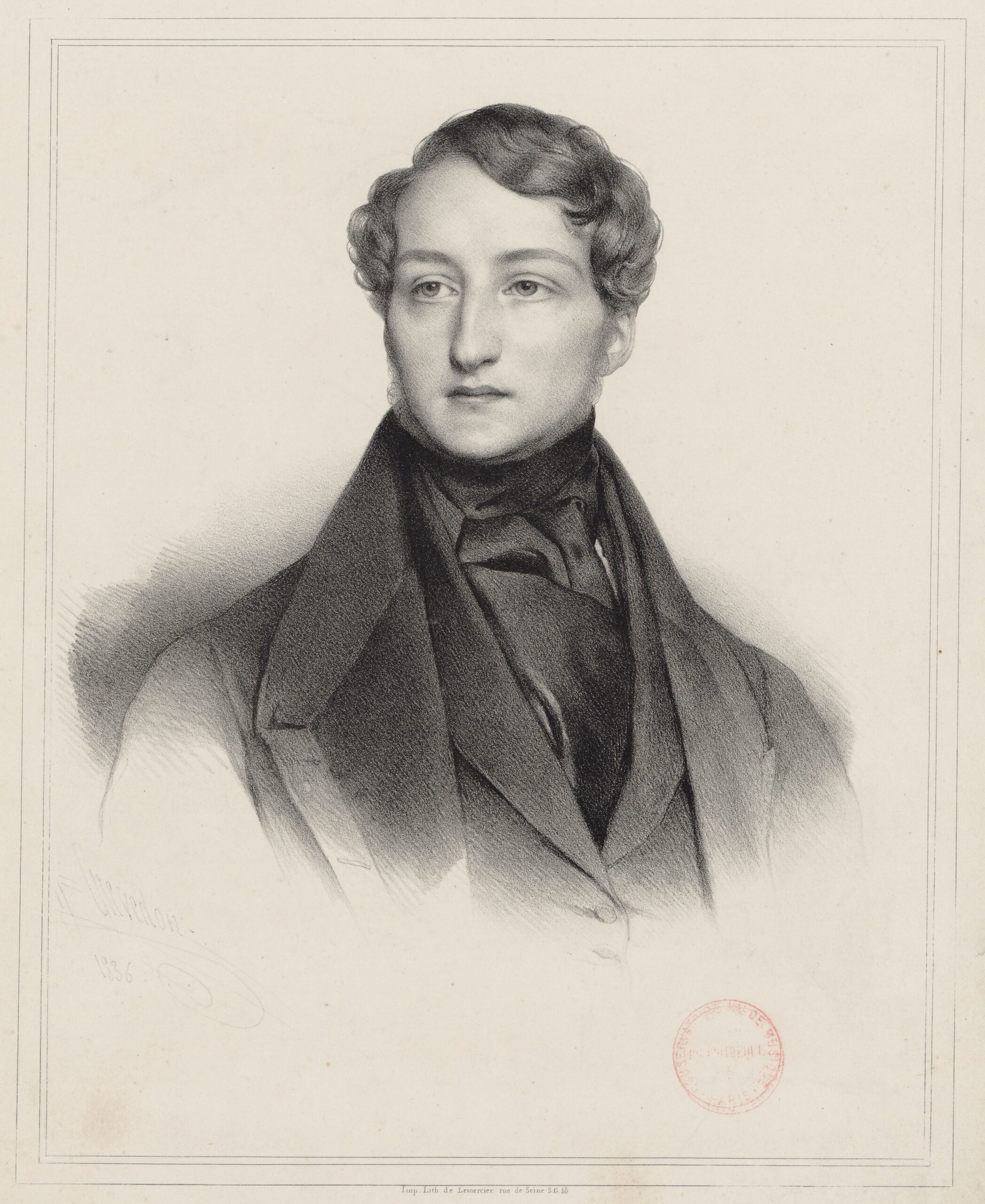
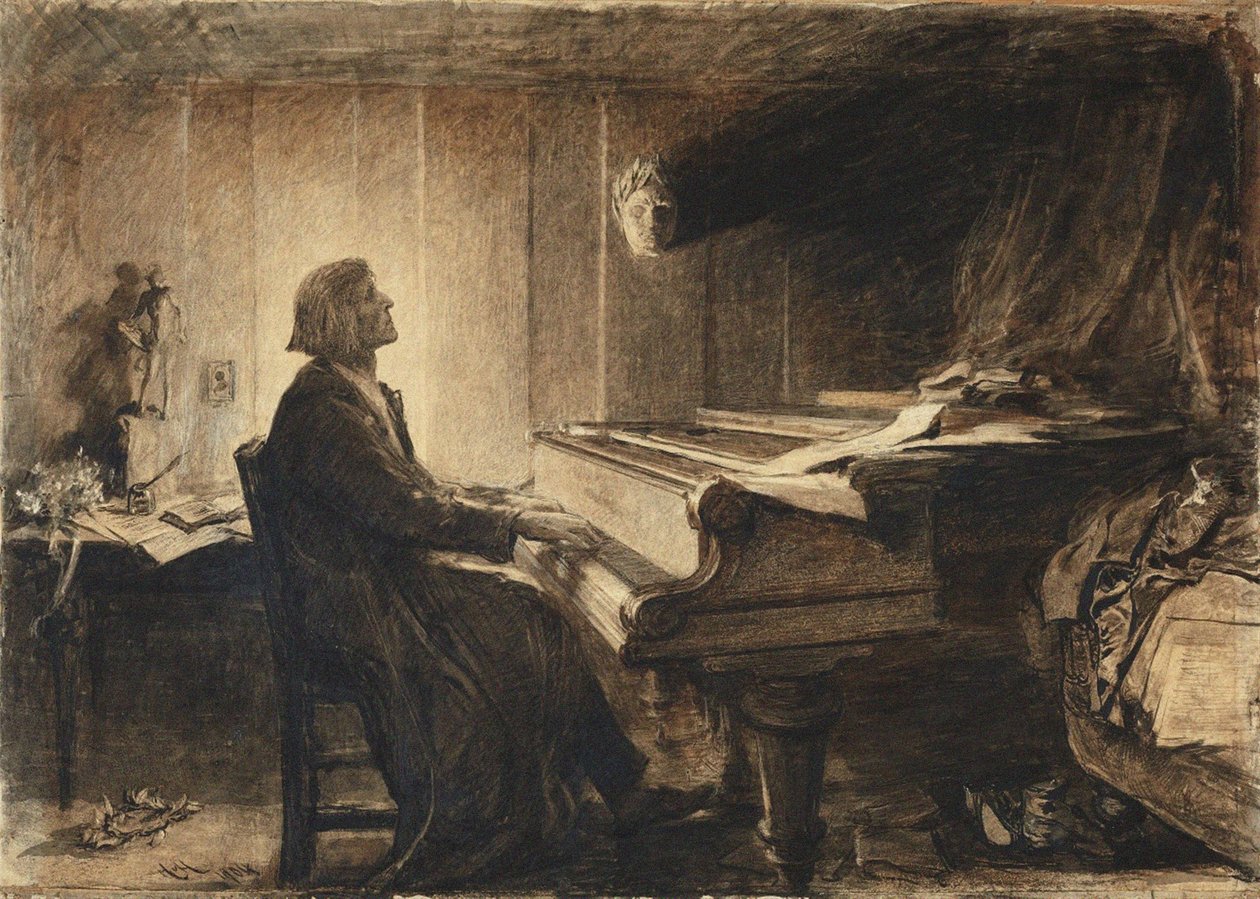
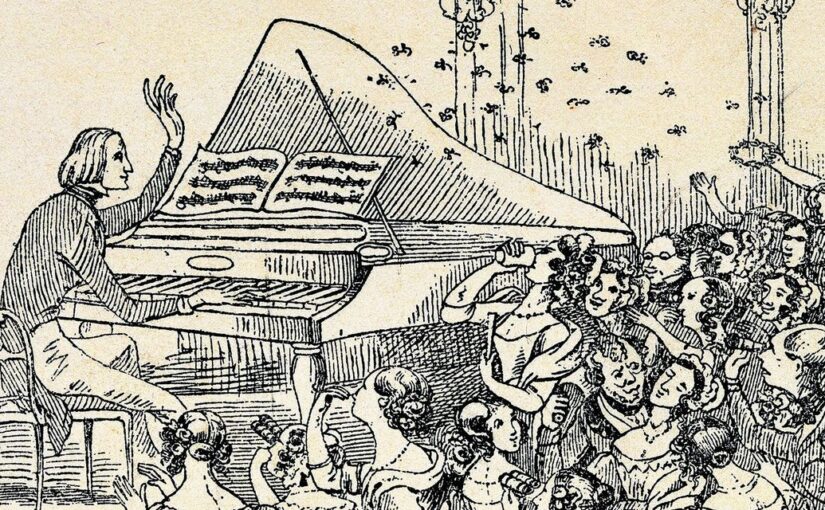
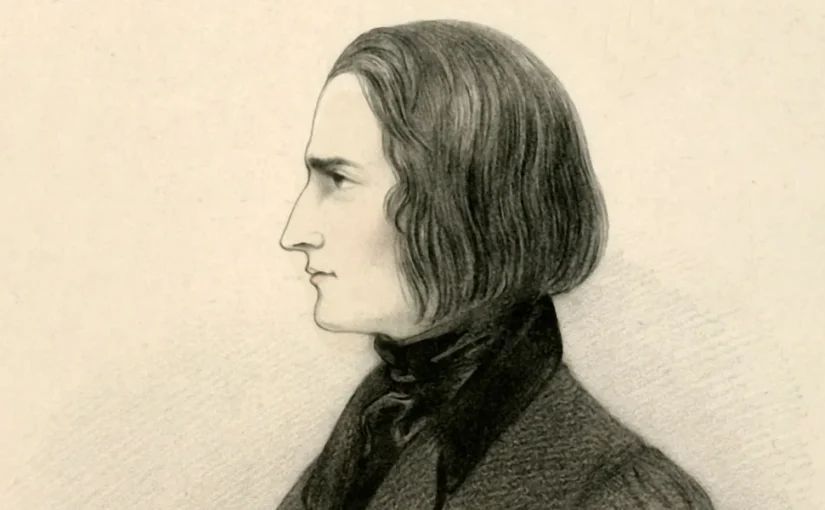
Liszt playing the piano in his late life. Notice how he no longer holds the same vivacity nor the same proud, confident composure of his virtuoso years. The darkness and eminence of fate hold him in great contemplation.

Liszt was fickle with marking the purpose of the Two Concert Etudes. The set of two piano works was dedicated to Dionys Pruckner, a student of Franz Liszt from a decade earlier in Weimar who had begun his own touring and had assumed the role of pedagogue at Stuttgart Conservatory. The dedication, however, is markedly confusing because the pieces were intended for Ludwig Stark and Sigmund Lebert, both piano professors and co-founders of the Stuttgart Conservatory. Liszt composed the pieces for the duo’s Grosse theoretisch-praktische Klavierschule, a piano method famous at the time, which was translated into multiple languages and printed throughout Europe. Though published in 1858, it gained fame especially in its fourth edition format in 1870. 

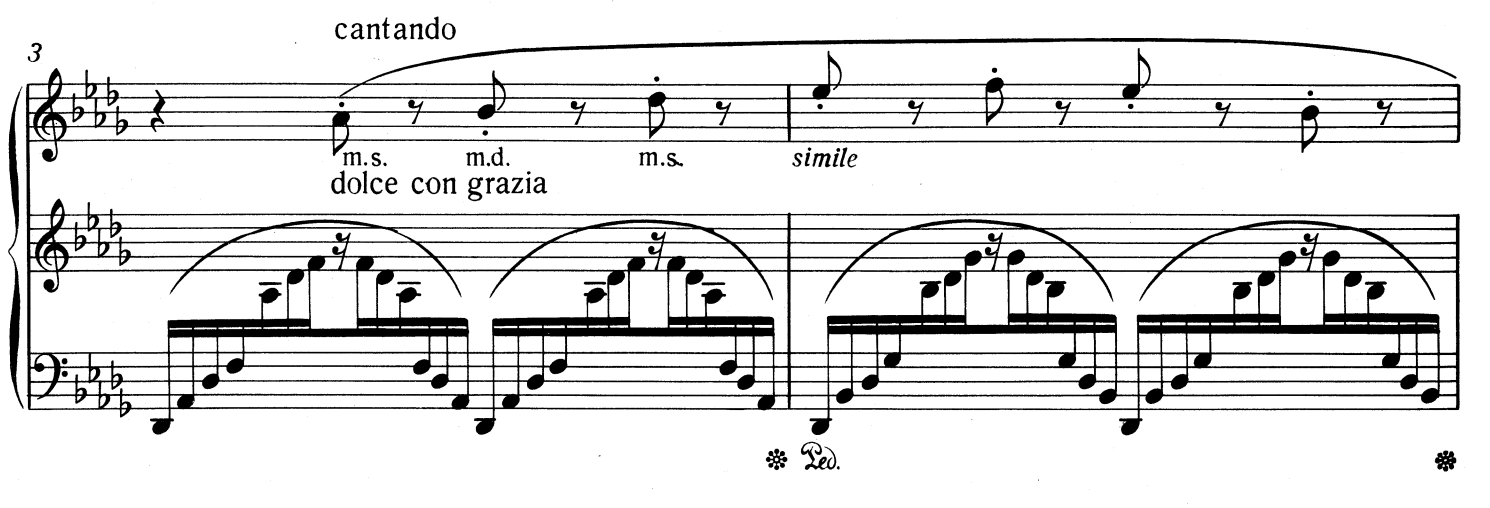
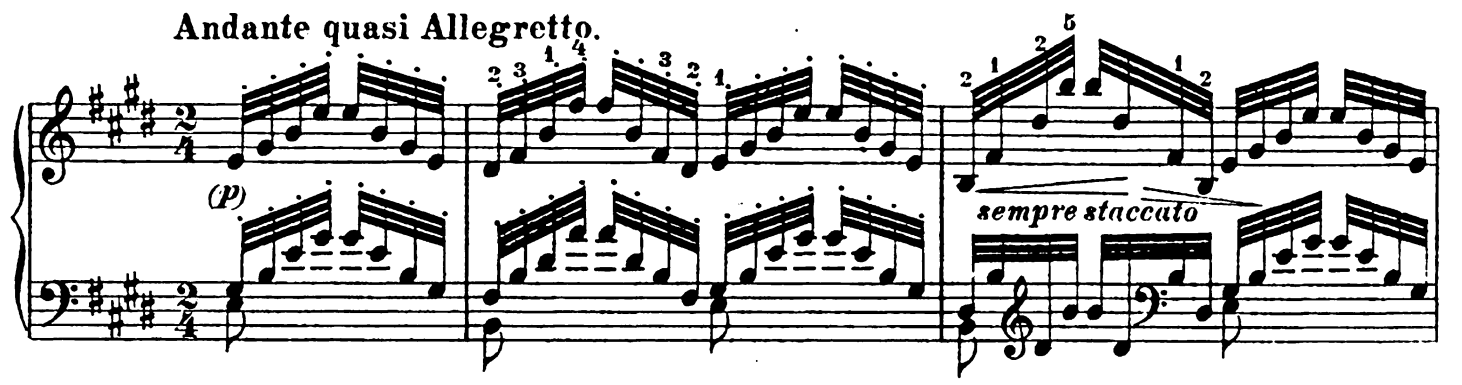
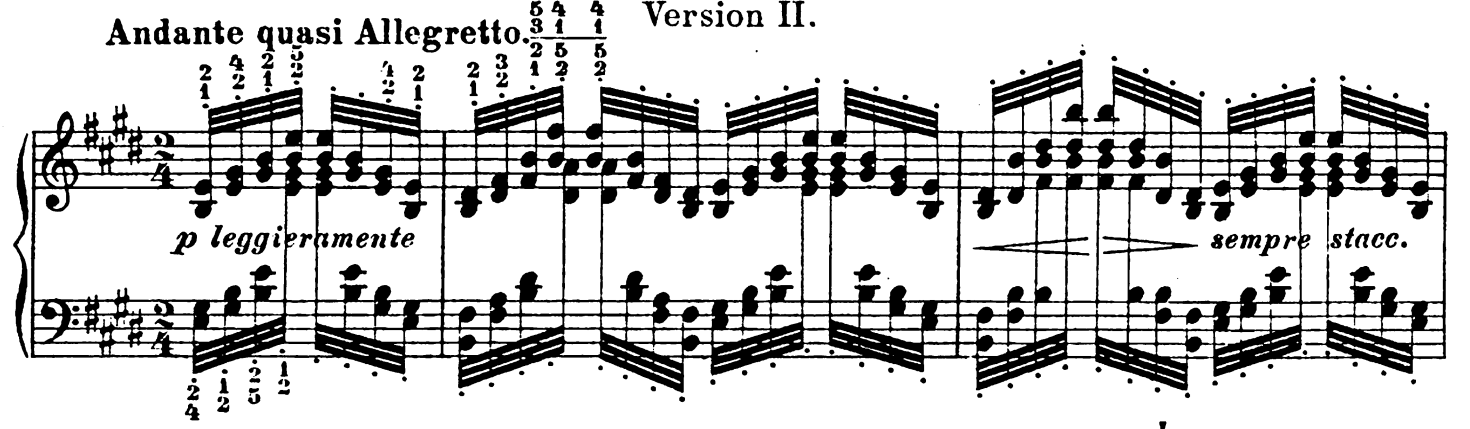
The first piece in the set, “Waldesrauschen,” is the lesser-played of the two and is in D-flat major. The piece is actually quite beautiful, evoking strong imagery of wind echoing throughout the forest. In some ways, it is similar to the earlier “Au lac de Wallenstadt” from the first Années de Pèlerinage S.160. Its title translates to “forest murmurs.” The tempo marking is “vivace,” and yet most recordings take it quite slowly. Like most romantic etudes, “Waldesrauschen” transcends the typical classical-era interpretation of the style (which often followed the etude’s literal meaning of “study,” emphasizing mechanics and the development of near-robotic technique). And yet, behind the flowing song-like melody in the left hides a secondary purpose for the piece’s composition: the repeating right-hand accompaniment that builds individual finger control. The voices then swap hands, with the ever-constant humming harmony echoing in the left hand and the melody strengthened as octaves in the right.

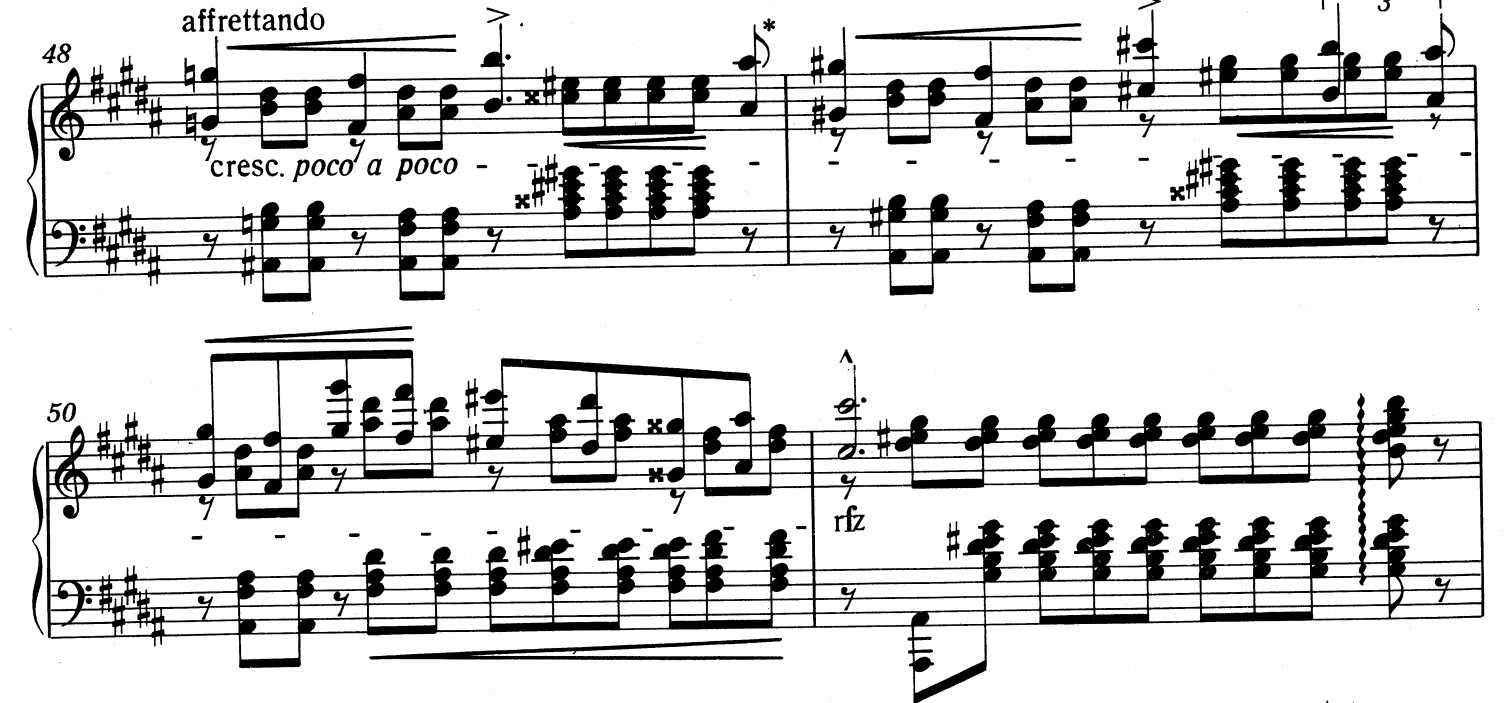
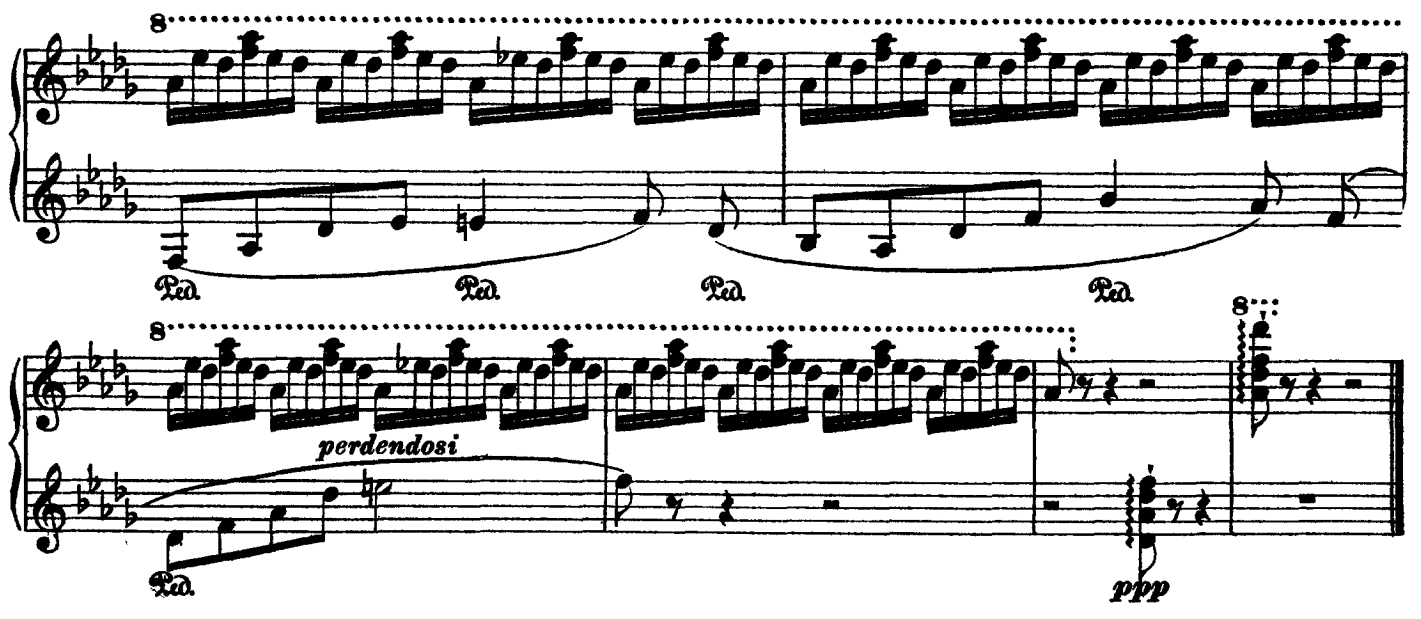
The dissipation of the right-hand harmonic “hum” as in “Waldesrauschen.” Sheet music from Breitkopf & Härtel.

The developmental middle section brings a dramatic turn to the music: decisive, passionate octaves in the right hand resonate with the extremely cadential left hand, which rapidly ascends and descends. The techniques and phrasing used in this part draw connections to Liszt’s B-minor Sonata S.178, which was written nearly a decade ago, thus placing this composition firmly in the crossroads between the Weimar age that musicologists deem as Liszt’s golden era of composition and his late phase. Then, at the end, Liszt has the right-hand accompaniment fade slowly away, ending with a ppp rolled tonic chord in the middle register, followed by an even softer tonic “murmur” in the upper register. The similarities of “Waldesrauschen” to Liszt’s other sentimental middle-late compositions remain quite uncanny. Characteristically, Liszt’s “Waldesrauschen” features the common usage of the sixth chord, which Liszt employed in many of his introspective, often religious compositions.

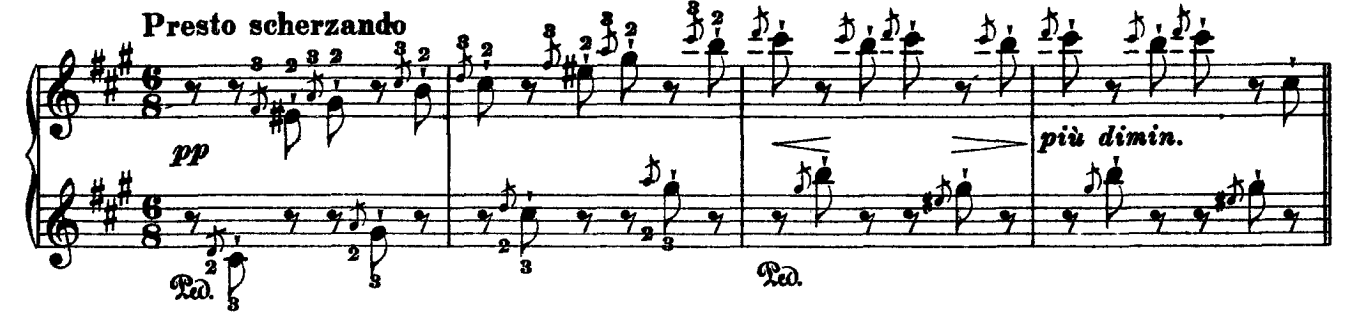
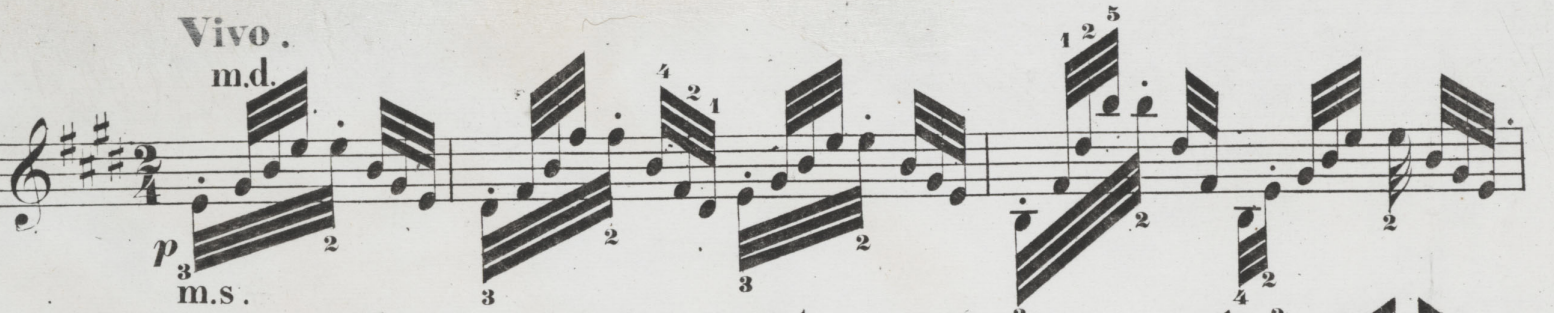
“Gnomenreigen” serves as quite a contrast to its previous companion. Pianists choose to perform it in concerts and competitions due to its technical difficulty. The translation of the title (“Round dance of gnomes”) suggests the imitation of magical creatures known to be stout, light, and yet quick. The tempo marking reflects this sentiment: “Presto scherzando.” Not only does Liszt require utmost speed, but he also insists on maintaining the scherzo-like nature of gnomes, which ultimately entails lightness and precision amidst fast passages. If it was not obvious enough, the fifth measure marks “staccato e leggierissimo,” meaning “detached and very light,” which verifies Liszt’s intentions. The piece’s central theme begins in F-sharp minor, emphasizing quick grace notes. Liszt then elaborates this in an A-major variation with an exceptionally fast right-hand under the marking of “Un poco più animato.”

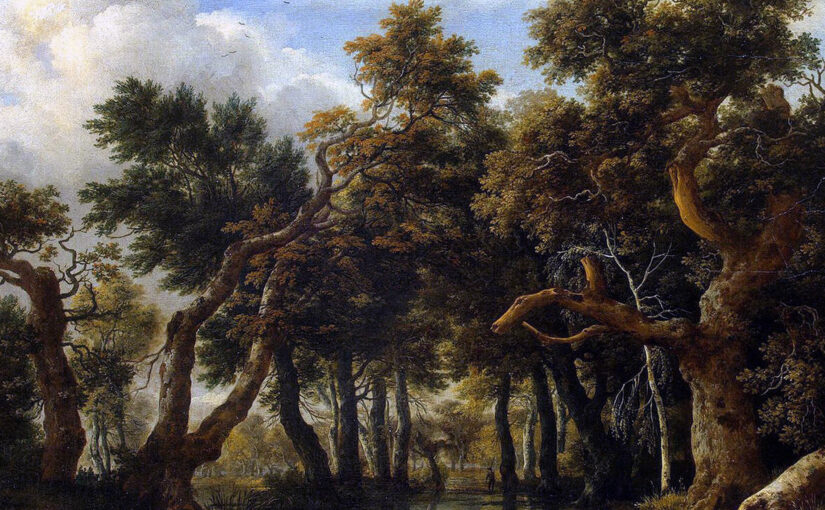
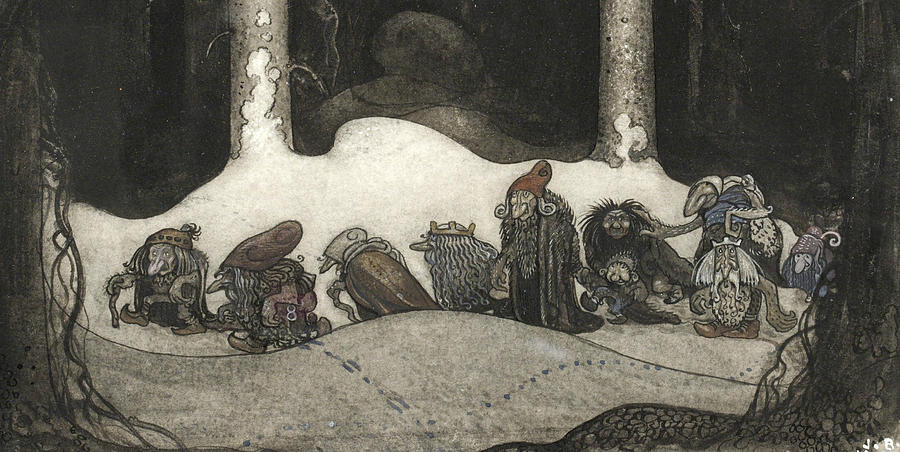
Visual representation of the gnomes from popular legend as depicted in “Gnomenreigen.”

The first theme and its elaboration repeat in B-flat major in a similar fashion, and then the music suddenly takes a “dark” turn as the key follows suit into the relative minor: the passage dips into the bass-clef area in a mysterious and earnest development. The section contains 54 consecutive bass “D” notes in an ostinato manner. F-sharp minor then grows into a grand recapitulation of the second elaborative theme. Then the soft first theme suddenly swallows the piercing climactic passage, as if the gnomes were returning underground after their fanfare, and the entire composition were a dream. Yet notably, “Gnomenreigen” ends on a F-sharp major (the parallel major of the initial key!) ascending arpeggio, suggesting Liszt’s optimistic, upward-looking objective for it. Perhaps Liszt honestly did believe in the good luck of gnomes.

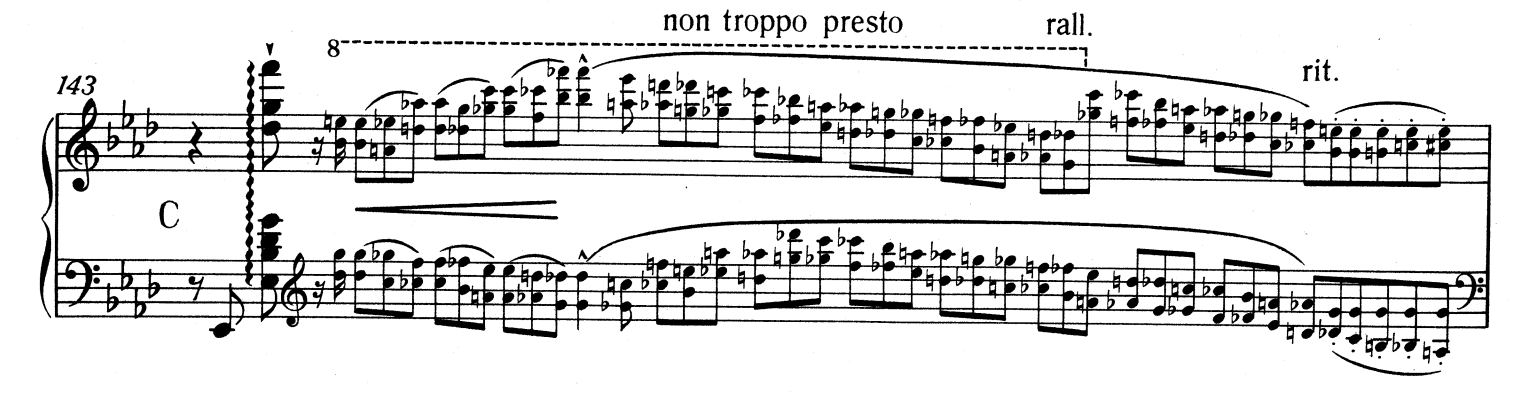
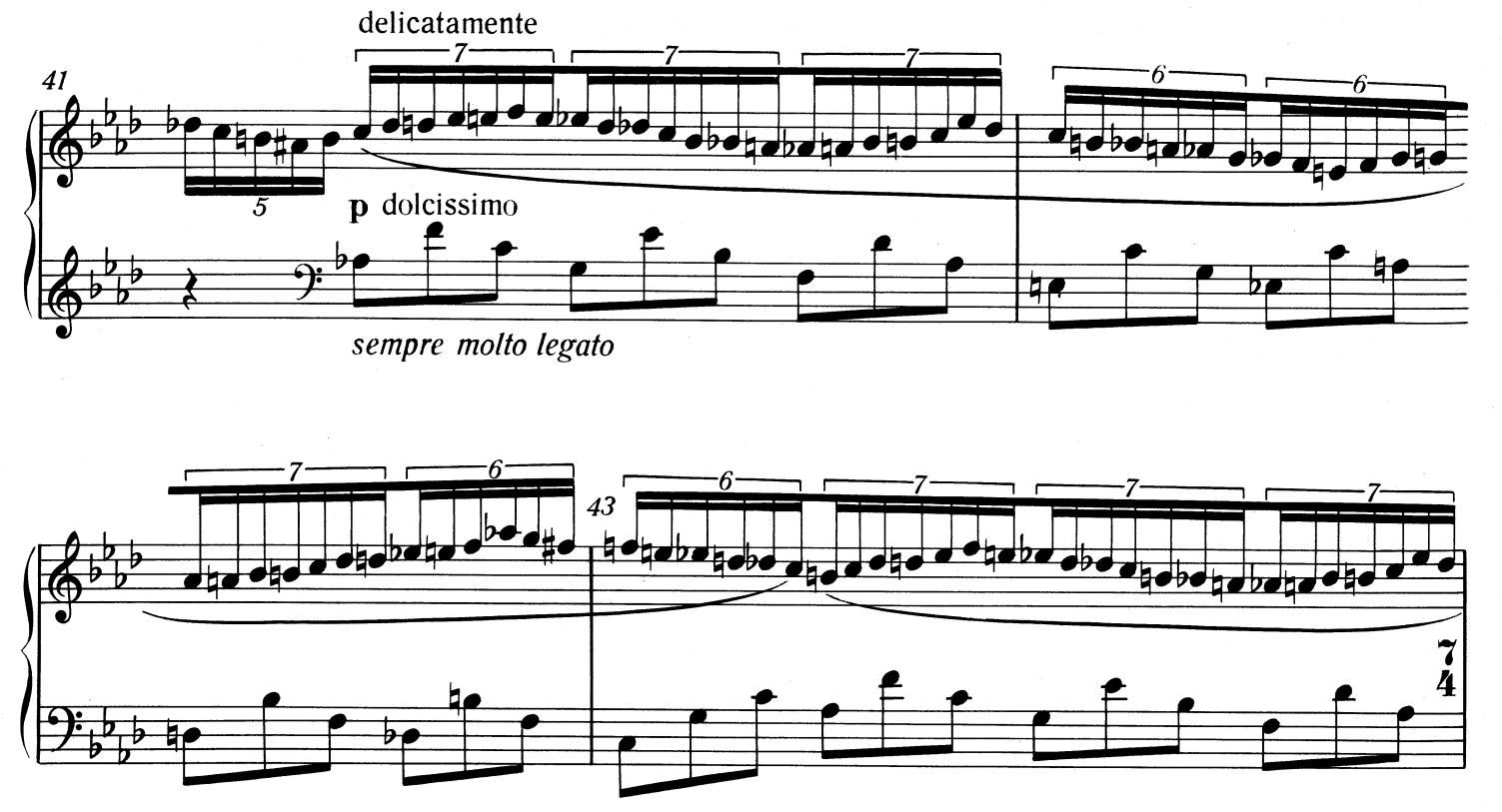
Sharp, attacking ornamented eighth notes. Though not technically difficult to play the right notes, it is quite challenging to perform at tempo with good tone quality and color. Sheet music from Breitkopf & Härtel.

Luckily, unlike many of Liszt’s pieces, the Two Concert Etudes gained popularity for a short period of time and maintained a relatively favorable status even after their creator’s passing. Perhaps the Zwei Konzertetüden’s success arises from their combination of quintessential early romanticism with the proto-impressionist flair of the very late 19th century, making them musically and historically rich. The pieces are representative of a changing European musical landscape where music itself was no longer homogeneous: taste grew diverse and fragmented, and visionary artistic leaders established different schools of music that advanced Western music in their own ways (namely, Leipzig’s conservative school, Wagner’s New German School, and even the Russian kuchka). As Liszt’s popularity declined with the arrival of a new generation of piano virtuosos, he reached a level of emotional maturity and artistic development that fundamentally altered his musical output.

Grandeur in the Paganini etudes

Before his fame as a composer, Liszt toured Europe as a child prodigy. Growing up in a lower-class family in Hungary, Liszt could have only dreamt of the journeys he would take through Romantic-era Europe if his faithful father, Adam Liszt, had not devoted himself to his son. Adam, who personally taught Liszt the piano in their humble cottage in the small town of Raiding, eventually sent his talented young son to Vienna for coaching from the esteemed pianist Carl Czerny, and later accompanied him on performance tours across Europe. The funding for these journeys came from wealthy Hungarian nobles whom Adam Liszt managed to convince after his son performed at a salon in the palace of the Esterházys. The Esterházys were perhaps the most significant Hungarian noble family, whose Nikolaus II famously supported Haydn, Beethoven, and Hummel financially.

However, in 1827, Adam Liszt passed away from typhoid fever. Devastated and alone in his musical endeavors, Liszt navigated the complex Parisian society as a newcomer. Soon, however, he would make a major breakthrough in his art. In 1832, Liszt had an epiphany after attending Niccolò Paganini’s concert at the Paris Opera House. An infamously talented violinist, Paganini took the European world by storm with his exceptional technique and compositions, all the while pioneering the concept of a touring musician. Whenever a piece was thought to be impossible, Paganini came and performed it with perfect accuracy and musicianship. Thought to have sold his soul to the devil in exchange for “devilish” fingers, Paganini impressed Liszt so much that Liszt would vow to become a comparable virtuoso as Paganini on the piano. Liszt would increase his practice time to up to 14 hours a day, and from this technical refining would arise the two legendary sets of Paganini études.

The first set of études, called Études d’exécution transcendante d’après Paganini, S.140, was published in 1838. The études followed the trend started by Robert Schumann in 1831. This set translates the virtuosity of Paganini into the keyboard. Though S.140 is forgotten in exchange for the more popular 1851 Grandes Études de Paganini, S.141, the early set contains many beautiful moments not present in the revision. Indeed, the results are just as impressive, if not more so, than the original melodies the set of études is based upon. Endless tremolos and leaps seem to demand hands of titanic size and fingers of arachnid-like mobility. Though catalogued as original Liszt works, the Paganini études are in nature much closer to transcriptions, offering very little new thematic material.

The first etude, Tremolo, was composed using the melody of Paganini’s sixth caprice, but it begins and ends with excerpts from the fifth caprice. The rumbling left-hand and lyrical right-hand melodies echo the original violin composition, but add layers of depth and range that the four stringed instrument cannot produce. The texture intensifies until the fifth caprice melody returns with thunderlike arpeggios and scales, finally concluding with a victorious doubled tonic. The individual hands imitate a violin duet, clearly paying tribute to the original Paganini study. In the first version from 1838, an ossia is present which inco.rporates Schumann’s Op. 10 no. 2. This ossia is not present in the later version from 1851.

The second etude uses Paganini’s seventeenth caprice and employs extensive use of rapid octaves. Glistening descending runs in the second half stand out against occasional periods of relative musical ease and quiet. 

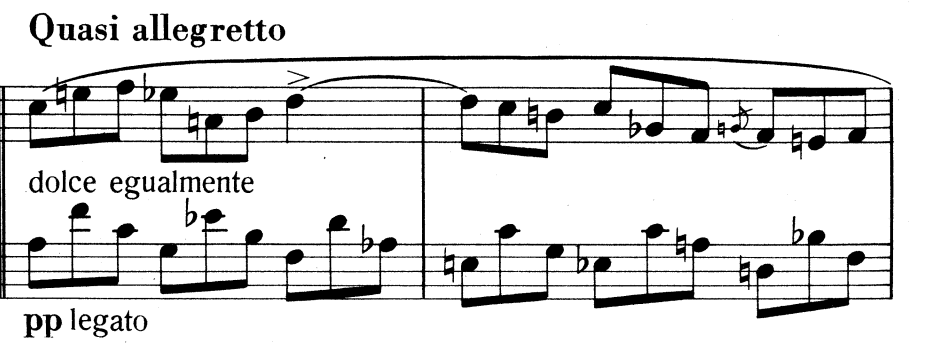
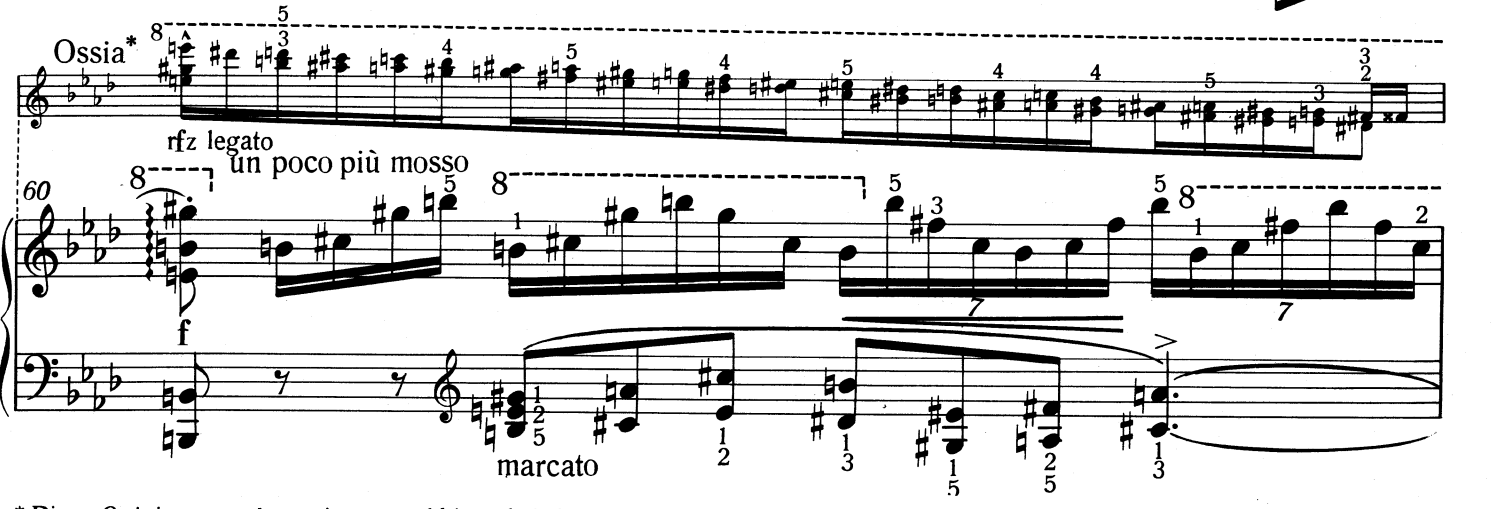
Melody from the final movement of Paganini’s first Violin Concerto used in the first edition that is absent in the more popular “La Campanella.” Sheet music from Breitkopf & Härtel.

The third etude from the 1838 set is, for better or for worse, outshined by its revision, known as La Campanella. Like its popular brother, the third etude from the 1838 set uses the bell melody from the Rondo of Paganini’s second violin concerto. The staccato of the bell remains prevalent through most of the piece. The version present in the early Études d’exécution transcendante d’après Paganini is arguably more faithful to the original melody in style and articulative marking. It requires a different type of technique, generally involving big hands and extremely independent fingers, whereas the revised Grandes Études de Paganini version focuses on jumps and more traditional skills. Uniquely, the early version incorporates themes from the final movement of Paganini’s first violin concerto, melodies that are absent in the later version. Liszt does not stay faithful to the B minor key of the original Paganini work, but instead opts for G sharp minor, shifting the notes in large jumps onto the black keys, thus making them more manageable to play. Overall, this work maintains a highly playful and upbeat mood, contrasting with the revision’s more serious and mature approach typical of middle-aged Liszt.

The fourth etude in the Études d’exécution transcendante d’après Paganini has, in the digital era, exploded to mythical status. The work itself is based on Paganini’s first caprice, which tests the violinist’s ability to bounce the bow off of the strings. Liszt provides two versions of the same piece: a first version labeled “4a,” which in itself is pretty challenging and tests the performer’s stamina and ability to move the fingers and arms quickly. However, the second version, called “4b,” is much more difficult, testing the abilities of the performer with large leaps and thick chordal writing. Many erroneously try to play this “4b” version at the speed of the original caprice, but Liszt’s tempo marking indicates that it shouldn’t be played nearly that fast. The version included in the 1851 set of études is much more refined, and the technique required is clearly intended to reflect the technique that the caprice features.

The fifth etude, “La Chasse,” is a beautiful and comparatively calm addition to the set, truly softening the otherwise firm and sometimes abrasive album. Initially a study on double-stops in the original ninth caprice, Liszt rewrites the voicing and lines to maintain a balance between faithfulness and effectiveness on a different instrument. A warm melodic line reminiscent of holiday music opens to a fiery passage evocative of the violin spiccato. The dolcissimo carries to the end, until the final chords are played with an awaking resolve and firmness. In the 1838 version, a much thicker texture is used, while the 1851 version is more laid back. The 1838 version includes an ossia which persists for nearly the entire étude, leading some to separate this early étude into two separate versions.

The sixth étude is based on the most famous of the caprices, number 24. The étude is structured as a theme with variations, similar to the original caprice. Many composers would later write variations on this same theme due to its versatility and recognizable rhythm. The 1838 version has some differences in the variations, but overall, the 1851 version of the étude is noticably improved in its voicing and texture.

In 1851, the Hungarian composer revised the early Paganini études into the Grandes Études de Paganini, S. 141. This set of pieces is stripped of the unnecessary difficulties of the early set, and includes many more refined textures and transitional sections. Like the S. 140 études, the S. 141 études are also dedicated to Clara Schumann. Renowned Liszt scholar Leslie Howard describes this relationship in the program notes of his recording of the études, writing:

“Liszt dedicated the 1838 set of studies to Clara Schumann and, for all her carping ingratitude, went on happily to dedicate the 1851 set to her as well.”

The ingratitude which Howard writes about refers to Clara Schumann’s strong distaste for Liszt’s compositional style, which she most notably expressed about these études and the Sonata in B minor.

The first and second S. 141 études are both remarkably similar to their predecessors. The motive and thematic material are identical, and the execution of pianistic prowess is visibly more refined. Liszt had, at this point, matured from his virtuosic early years in Paris. Living in Weimar as Kappelmeister, he truly honed his compositional abilities after his touring years came to an end. Here too we see the dilution of texture which is very common in Liszt’s constant process of revision.

The 1851 La Campanella could not be any more different than the 1838 version. Though it is just as technically demanding, the techniques used are quite different. The extended range in both hands and the articulative “capricious” tone present in the 1851 version contrasts with the 1838 version, which is more similar in style to the original Paganini study. However, the two versions of this étude are just some of the pieces composed after Paganini’s Clochette melody. Also among these compositions are the two large scale works numbered as S. 420 and S. 700i (a second version of this piece is catalogued as S. 700ii).

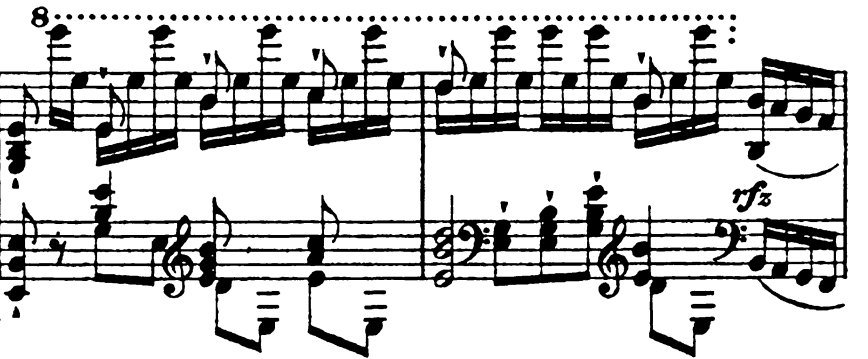
The Grandes Études de Paganini etude no. 4. Note the layout of this work on a single staff rather than two. Sheet music from Breitkopf & Härtel.
Version 4a of the Études d’exécution transcendante d’après Paganini. Sheet music from Breitkopf & Härtel.
Version 4b of the Études d’exécution transcendante d’après Paganini. Sheet music from Breitkopf & Härtel.

Out of the three versions, the fourth étude of the 1851 Grandes Études de Paganini is most consistent with the violin caprice. This version offers very few deviations from the original caprice in comparison with the two versions of 1838.

The fifth and sixth études do not have major differences between the originals and the revisions. The charges made are mostly improvements in texture, as well as the removal of unnecessary complexity not consistent with the character of the music.

Liszt’s two sets of Paganini études are very difficult works that require years of dedication and practice to perform well. The technical writing presented in these études is a testament to the magnificent Paganini, who took the world by storm with his incredible ability on the violin. Analysis of the differences between these works reveals Liszt’s incredible evolution as an artist and his ability to balance difficult technical writing with musical expression.