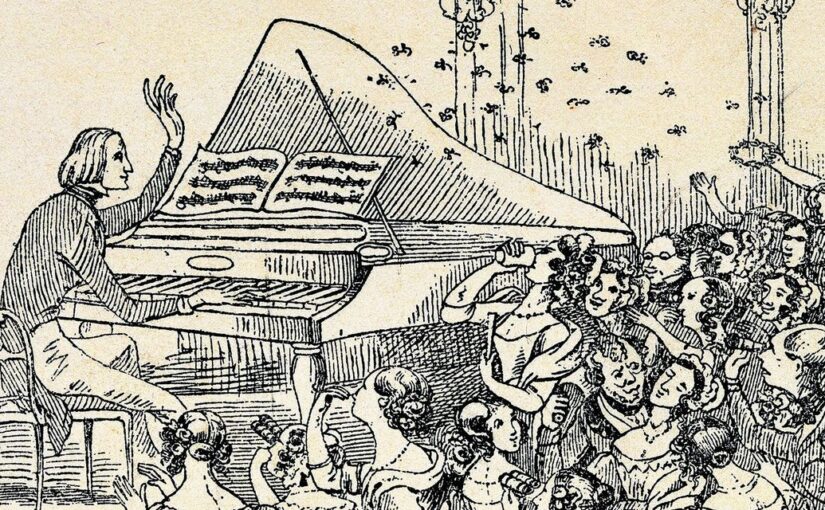
Franz Liszt’s Liebesträume No. 3, S. 541/3, is one of Liszt’s few compositions widely recognized by the general public. Its short structure and lovely melody also make it a great entry point into the composer’s piano music. Yet, so much of the piece’s history and structure is overlooked, especially considering the many versions and arrangements of this short nocturne.
This piece is the third of three liebesträume (“Dreams of Love”), although the first two are seldom performed or heard in general. Liebesträume No. 3 is actually an arrangement for solo piano of the song “O lieb so lang du lieben kannst,” S.298. The song itself is scored for voice and piano, using a text by Ferdinand Freiligrath. It exists in two versions, catalogued as S.298/1 and S.298/2, respectively. The first one was written in 1847, while the second was written three years later. The piano version on which this article focuses was written and published in 1850.
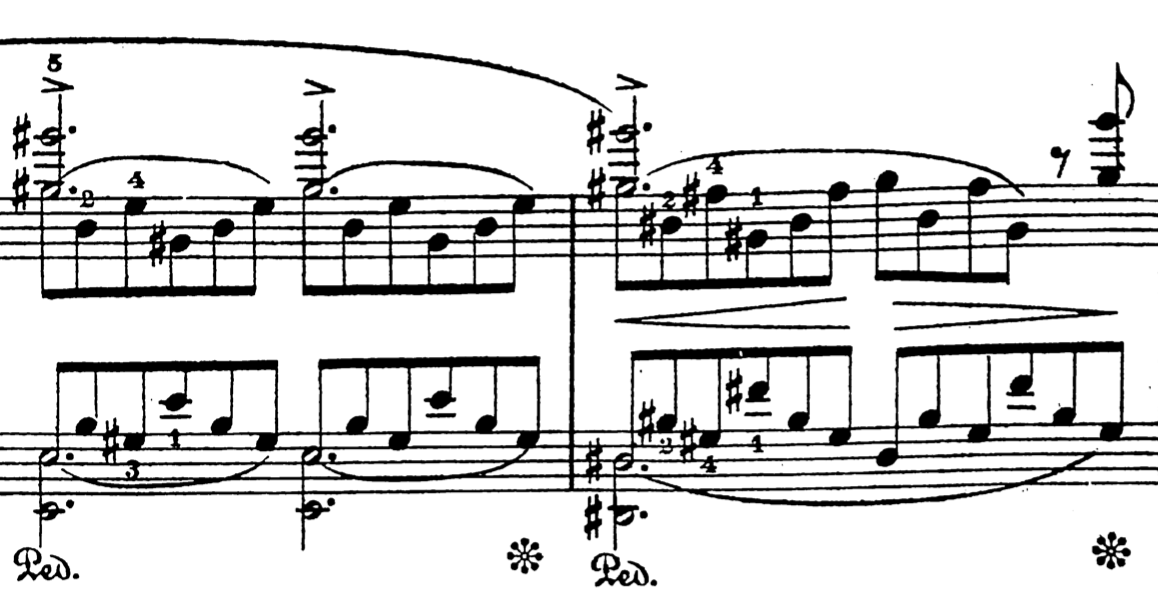
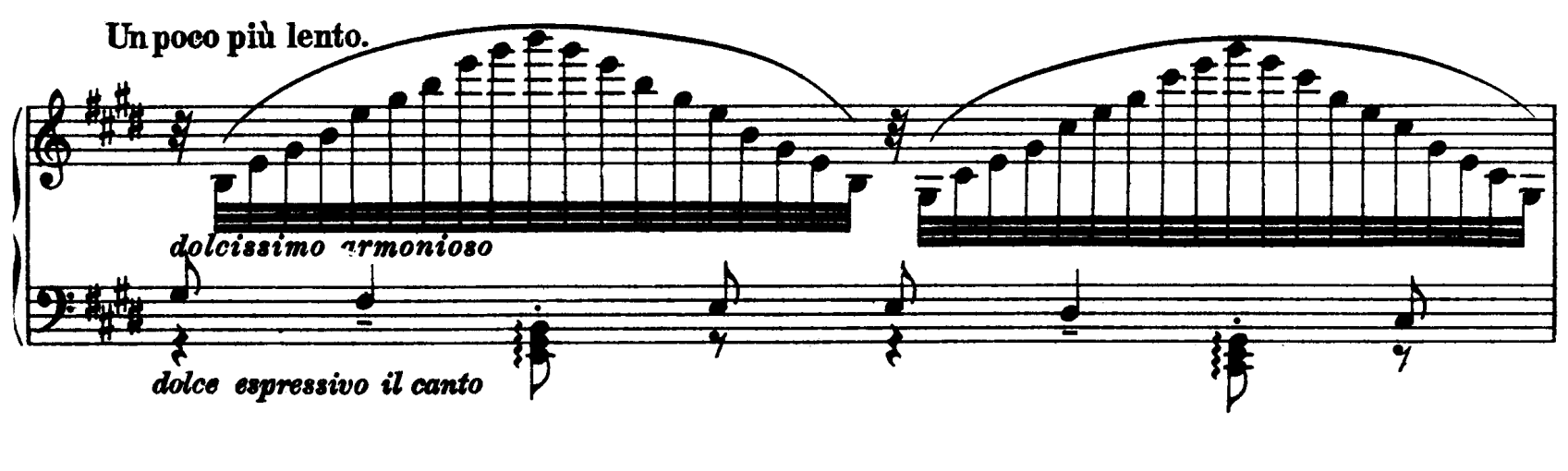
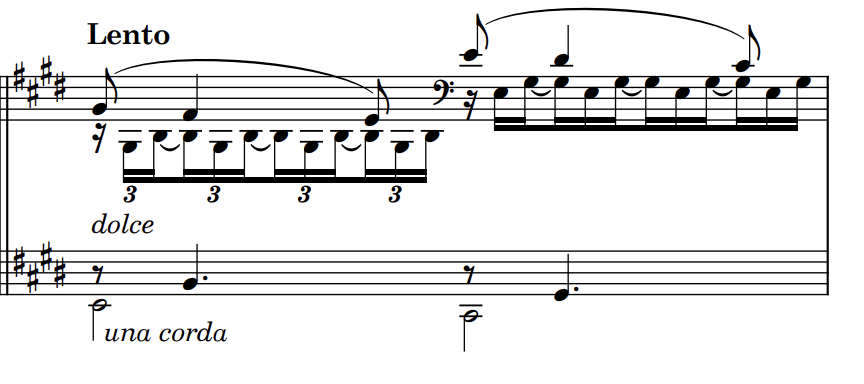
The piece is in A-flat major. It begins with the melody surrounded by slow arpeggios, but quickly builds up to the first of two virtuosic cadenzas. These cadenzas are the most difficult parts of Liebesträume No. 3, requiring technical proficiency and precise control of volume. The climax of the piece takes place between the two cadenzas, where the song melody is played in octaves by the right hand, while arpeggiated patterns are played by both hands in the middle register of the piano.
Two measures from the climactic middle section. The melody is clearly evident in the right hand. Sheet music edited by Isidor Philipp and published by Costallat.
The piece ends much more quietly, rather than fading out. Here, Liszt demonstrates incredible skill in modulation: exposition and recapitulation are in A-flat major, while the middle development section is in B major.
In addition to the piano solo and voice and piano versions of this piece, Liszt also wrote an introduction and ending to the piece in the form of Einleitung und Schlußtakte zu Liebesträume III, S.135b, for harp. This was written by Liszt after Wilhelm Posse arranged Liebesträume No. 3 for harp.
Ultimately, Liebesträume No. 3 is a quintessential example of Romantic musical thought as it seeks to explore emotion and human experience rather than to pursue an intricate structure. It also showcases Liszt’s ability to arrange songs for piano, a skill he had developed through his many song transcriptions after Schubert (famously including Ständchen S.560/7 and Erlkönig S.558/4).
“Rene, what a man, what a violin, what an artist! Heavens! What sufferings, what misery, what tortures in those four strings!”
Franz Liszt
Before his fame as a composer, Liszt toured Europe as a child prodigy. Growing up in a lower-class family in Hungary, Liszt could have only dreamt of the journeys he would take through Romantic-era Europe if his faithful father, Adam Liszt, had not devoted himself to his son. Adam, who personally taught Liszt the piano in their humble cottage in the small town of Raiding, eventually sent his talented young son to Vienna for coaching from the esteemed pianist Carl Czerny, and later accompanied him on performance tours across Europe. The funding for these journeys came from wealthy Hungarian nobles whom Adam Liszt managed to convince after his son performed at a salon in the palace of the Esterházys. The Esterházys were perhaps the most significant Hungarian noble family, whose Nikolaus II famously supported Haydn, Beethoven, and Hummel financially.
However, in 1827, Adam Liszt passed away from typhoid fever. Devastated and alone in his musical endeavors, Liszt navigated the complex Parisian society as a newcomer. Soon, however, he would make a major breakthrough in his art. In 1832, Liszt had an epiphany after attending Niccolò Paganini’s concert at the Paris Opera House. An infamously talented violinist, Paganini took the European world by storm with his exceptional technique and compositions, all the while pioneering the concept of a touring musician. Whenever a piece was thought to be impossible, Paganini came and performed it with perfect accuracy and musicianship. Thought to have sold his soul to the devil in exchange for “devilish” fingers, Paganini impressed Liszt so much that Liszt would vow to become a comparable virtuoso as Paganini on the piano. Liszt would increase his practice time to up to 14 hours a day, and from this technical refining would arise the two legendary sets of Paganini études.
The first set of études, called Études d’exécution transcendante d’après Paganini, S.140, was published in 1838. The études followed the trend started by Robert Schumann in 1831. This set translates the virtuosity of Paganini into the keyboard. Though S.140 is forgotten in exchange for the more popular 1851 Grandes Études de Paganini, S.141, the early set contains many beautiful moments not present in the revision. Indeed, the results are just as impressive, if not more so, than the original melodies the set of études is based upon. Endless tremolos and leaps seem to demand hands of titanic size and fingers of arachnid-like mobility. Though catalogued as original Liszt works, the Paganini études are in nature much closer to transcriptions, offering very little new thematic material.
The first etude, Tremolo, was composed using the melody of Paganini’s sixth caprice, but it begins and ends with excerpts from the fifth caprice. The rumbling left-hand and lyrical right-hand melodies echo the original violin composition, but add layers of depth and range that the four stringed instrument cannot produce. The texture intensifies until the fifth caprice melody returns with thunderlike arpeggios and scales, finally concluding with a victorious doubled tonic. The individual hands imitate a violin duet, clearly paying tribute to the original Paganini study. In the first version from 1838, an ossia is present which inco.rporates Schumann’s Op. 10 no. 2. This ossia is not present in the later version from 1851.
The second etude uses Paganini’s seventeenth caprice and employs extensive use of rapid octaves. Glistening descending runs in the second half stand out against occasional periods of relative musical ease and quiet.
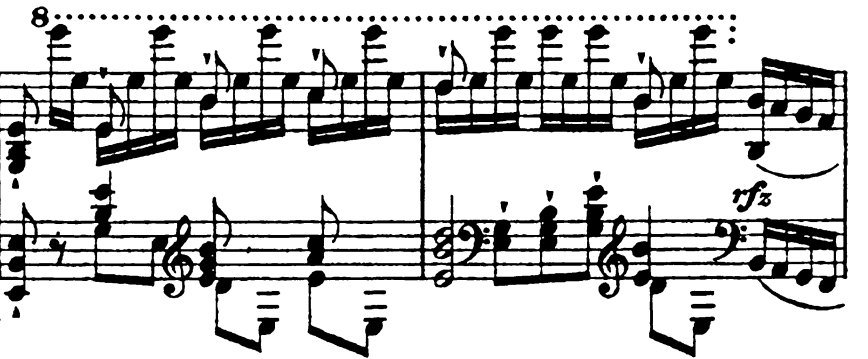
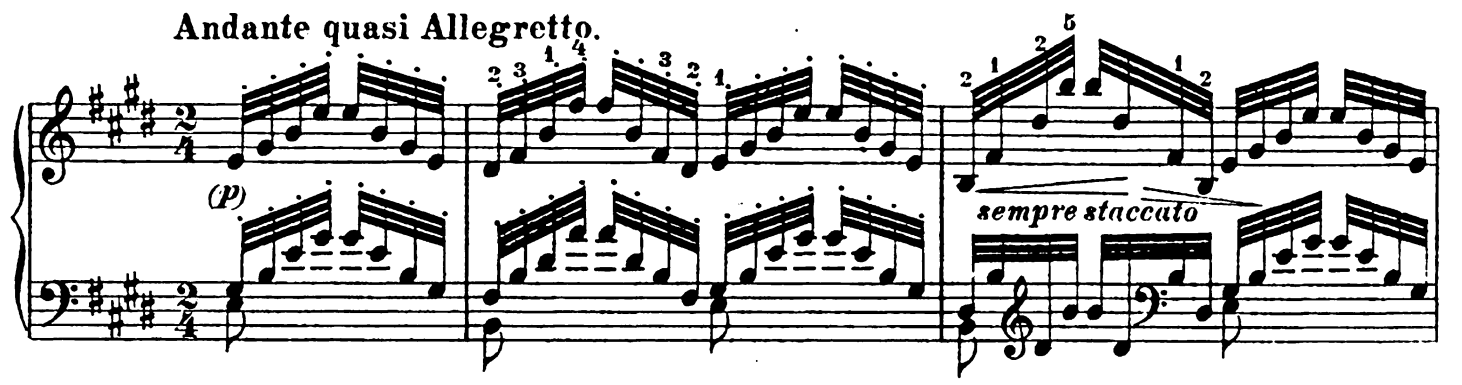
Melody from the final movement of Paganini’s first Violin Concerto used in the first edition that is absent in the more popular “La Campanella.” Sheet music from Breitkopf & Härtel.
The third etude from the 1838 set is, for better or for worse, outshined by its revision, known as La Campanella. Like its popular brother, the third etude from the 1838 set uses the bell melody from the Rondo of Paganini’s second violin concerto. The staccato of the bell remains prevalent through most of the piece. The version present in the early Études d’exécution transcendante d’après Paganini is arguably more faithful to the original melody in style and articulative marking. It requires a different type of technique, generally involving big hands and extremely independent fingers, whereas the revised Grandes Études de Paganini version focuses on jumps and more traditional skills. Uniquely, the early version incorporates themes from the final movement of Paganini’s first violin concerto, melodies that are absent in the later version. Liszt does not stay faithful to the B minor key of the original Paganini work, but instead opts for G sharp minor, shifting the notes in large jumps onto the black keys, thus making them more manageable to play. Overall, this work maintains a highly playful and upbeat mood, contrasting with the revision’s more serious and mature approach typical of middle-aged Liszt.
The fourth etude in the Études d’exécution transcendante d’après Paganini has, in the digital era, exploded to mythical status. The work itself is based on Paganini’s first caprice, which tests the violinist’s ability to bounce the bow off of the strings. Liszt provides two versions of the same piece: a first version labeled “4a,” which in itself is pretty challenging and tests the performer’s stamina and ability to move the fingers and arms quickly. However, the second version, called “4b,” is much more difficult, testing the abilities of the performer with large leaps and thick chordal writing. Many erroneously try to play this “4b” version at the speed of the original caprice, but Liszt’s tempo marking indicates that it shouldn’t be played nearly that fast. The version included in the 1851 set of études is much more refined, and the technique required is clearly intended to reflect the technique that the caprice features.
The fifth etude, “La Chasse,” is a beautiful and comparatively calm addition to the set, truly softening the otherwise firm and sometimes abrasive album. Initially a study on double-stops in the original ninth caprice, Liszt rewrites the voicing and lines to maintain a balance between faithfulness and effectiveness on a different instrument. A warm melodic line reminiscent of holiday music opens to a fiery passage evocative of the violin spiccato. The dolcissimo carries to the end, until the final chords are played with an awaking resolve and firmness. In the 1838 version, a much thicker texture is used, while the 1851 version is more laid back. The 1838 version includes an ossia which persists for nearly the entire étude, leading some to separate this early étude into two separate versions.
The sixth étude is based on the most famous of the caprices, number 24. The étude is structured as a theme with variations, similar to the original caprice. Many composers would later write variations on this same theme due to its versatility and recognizable rhythm. The 1838 version has some differences in the variations, but overall, the 1851 version of the étude is noticably improved in its voicing and texture.
In 1851, the Hungarian composer revised the early Paganini études into the Grandes Études de Paganini, S. 141. This set of pieces is stripped of the unnecessary difficulties of the early set, and includes many more refined textures and transitional sections. Like the S. 140 études, the S. 141 études are also dedicated to Clara Schumann. Renowned Liszt scholar Leslie Howard describes this relationship in the program notes of his recording of the études, writing:
“Liszt dedicated the 1838 set of studies to Clara Schumann and, for all her carping ingratitude, went on happily to dedicate the 1851 set to her as well.”
The ingratitude which Howard writes about refers to Clara Schumann’s strong distaste for Liszt’s compositional style, which she most notably expressed about these études and the Sonata in B minor.
The first and second S. 141 études are both remarkably similar to their predecessors. The motive and thematic material are identical, and the execution of pianistic prowess is visibly more refined. Liszt had, at this point, matured from his virtuosic early years in Paris. Living in Weimar as Kappelmeister, he truly honed his compositional abilities after his touring years came to an end. Here too we see the dilution of texture which is very common in Liszt’s constant process of revision.
The 1851 La Campanella could not be any more different than the 1838 version. Though it is just as technically demanding, the techniques used are quite different. The extended range in both hands and the articulative “capricious” tone present in the 1851 version contrasts with the 1838 version, which is more similar in style to the original Paganini study. However, the two versions of this étude are just some of the pieces composed after Paganini’s Clochette melody. Also among these compositions are the two large scale works numbered as S. 420 and S. 700i (a second version of this piece is catalogued as S. 700ii).
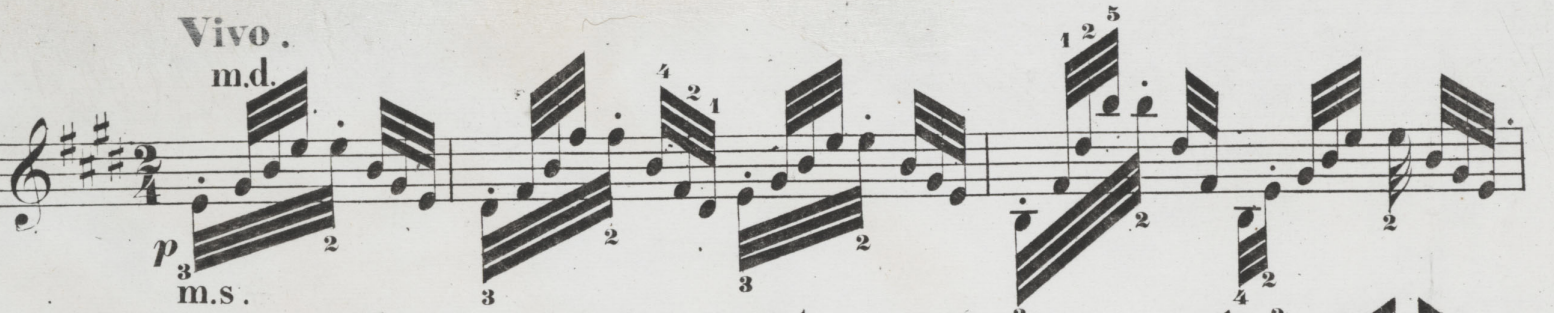
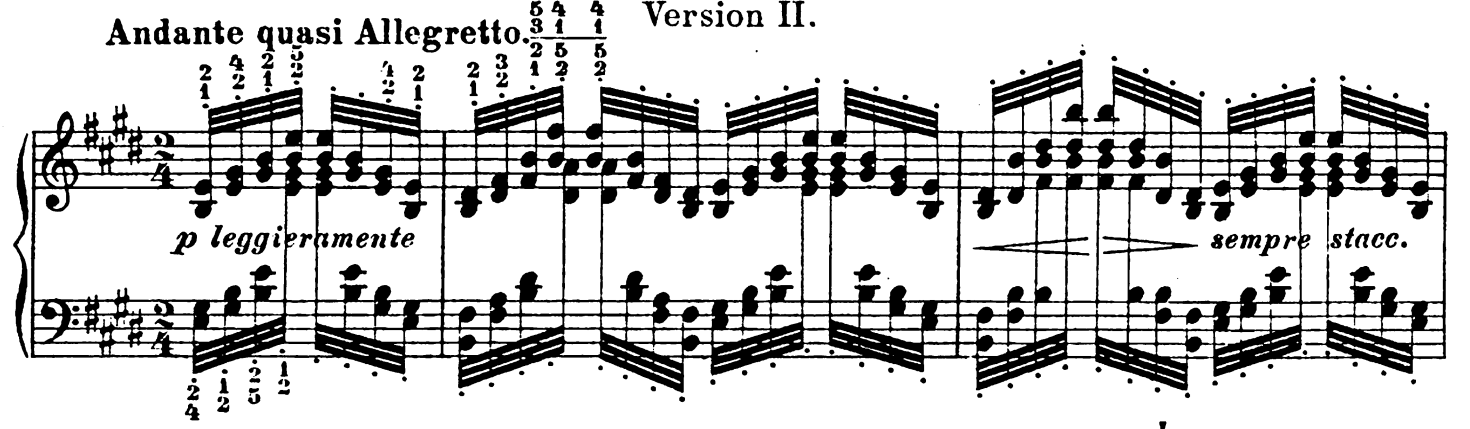
The Grandes Études de Paganini etude no. 4. Note the layout of this work on a single staff rather than two. Sheet music from Breitkopf & Härtel.Version 4a of the Études d’exécution transcendante d’après Paganini. Sheet music from Breitkopf & Härtel.Version 4b of the Études d’exécution transcendante d’après Paganini. Sheet music from Breitkopf & Härtel.
Out of the three versions, the fourth étude of the 1851 Grandes Études de Paganini is most consistent with the violin caprice. This version offers very few deviations from the original caprice in comparison with the two versions of 1838.
The fifth and sixth études do not have major differences between the originals and the revisions. The charges made are mostly improvements in texture, as well as the removal of unnecessary complexity not consistent with the character of the music.
Liszt’s two sets of Paganini études are very difficult works that require years of dedication and practice to perform well. The technical writing presented in these études is a testament to the magnificent Paganini, who took the world by storm with his incredible ability on the violin. Analysis of the differences between these works reveals Liszt’s incredible evolution as an artist and his ability to balance difficult technical writing with musical expression.
“But where of ye, O tempests! is the goal? Are ye like those within the human breast? Or do ye find, at length, like eagles, some high nest?”
Lord Byron
Franz Liszt settled in Paris in 1823 as a child prodigy after his brief but meaningful stay in Vienna, Austria, the once capital of music, to study under the wing of the famed pedagogue Carl Czerny. However, as the worlds of art and literature experienced the changes which came with the Romantic movement, so too did music move in a similar direction. Although the young Liszt learned a lot in Vienna, the capital of music in the early Romantic era was Paris, not Vienna. Liszt wished to study there and enter the Paris Conservatoire, but he was denied entry because he was a foreigner. Consequently, he was forced to study elsewhere and soon make a living with his talent. To rise to fame, Liszt needed to be different and to explore the limits of musical existence. The first year of the Années de pèlerinage, S.160, is a testament to that goal.
1835 was the year of Liszt’s elopement in Switzerland with his mistress, Countess Marie d’Agoult. Liszt was making his name in Paris, having formed strong friendships with other musicians such as Frédéric Chopin and Hector Berlioz. One of the results of this elopement was a daughter, named Blandine. The other result would be the Album d’un voyageur, S.156, supposedly named after a letter sent to Liszt by George Sand, Chopin’s lover, during the elopement. This letter, similarly called the Lettre d’un Voyageur, was incidentally published in the Revue des Deux Mondes for fortunate scholars of the present era to analyze. The Album was Liszt’s first major set of piano pieces. This was later revised in 1855 to become the well known Années de pèlerinage, Première année: Suisse, referred to in English as the “First Year: Switzerland.” This would not be the only year however, because later on, Liszt would write two more collections of pieces based on his other travels. These collections were named after Goethe’s famous novel Wilhelm Meister’s Apprenticeship, whose sequel was initially titled “Wilhelm Meisters Wanderjahre,” essentially meaning “Years of Wandering.”
Similarly to other predecessors like the Douze Grandes Études, S.137, and the Études d’exécution transcendante d’après Paganini, S.140, the Album d’un voyageur contains very different material than its later revisions. However, this Album, unlike the early étude collections, contain several pieces which simply are not present in the later revisions.
The Album d’un voyageur is divided into three “sub-albums.” The first, Impressions et poésies, contains a majority of the pieces found in the revised set. Scholars generally agree that this first sub-album is the most pertinent and influential of the three. The second, Fleurs mélodiques des Alpes, contains pieces meant to evoke various sentiments, ranging from serene, flowing melodies to upbeat and forward-looking march rhythms. However, this second sub-album also offers musicians a deeper insight into music that would ultimately be cut from the final Années de pèlerinage product. The music from both the first and second sub-albums creates an overarching contemplative narrative that settles perfectly into the ideals of Romanticism. The third subalbum, labelled Paraphrases, serves a completely different purpose however. The Paraphrases indeed serve not as works composed specifically to fit in with the Album d’un voyageur narrative, but actually were revisions of the early collection Airs Suisses. These would later be revised once again as the Morceaux Suisses. Of these three sub-albums, only the first two remain of high importance in the context of analyzing the first Years of Pilgrimage.
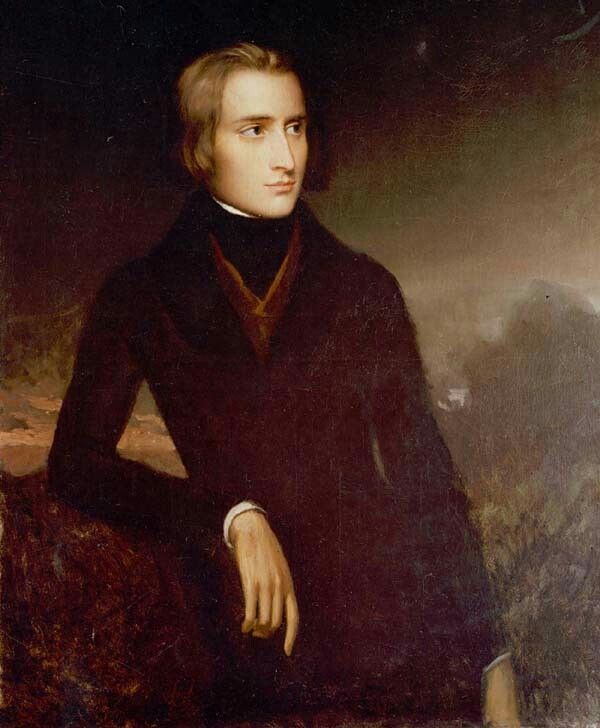
A portrait of Liszt in Geneva during his elopement in 1835.
The first entry of the Album d’un voyageur, called Lyon, is not present in the Years of Pilgrimage. It was inspired by an ongoing silk workers’ uprising in the city of Lyon, France, and was dedicated to Liszt’s early mentor Abbé Félicité de Lammenais. As with many of the works in the Album and Années, Lyon comes with a prefatory excerpt: “Vivre en travaillant ou mourir en combattant,” meaning “Live working or die fighting.” The triumphant melody, the complex and sometimes whimsical texture, and the use of chromatic octaves evoke the quintessential style of early Liszt, which is evident in earlier works like his fantasy after Auber’s opera La Fiancee , numbered as S.385 in Searle’s catalogue. The second entry, called Le Lac de Wallenstadt, is clearly a predecessor to the piece of the same name found in the First Year of the Years of Pilgrimage. Le Lac de Wallenstadt is also one of the pieces that Liszt provides a literary excerpt with, which in this case is taken from Lord Byron’s Childe Harold’s Pilgrimage, Canto 3.
Generally, the early versions found in the Album d’un voyageur are less refined than their Années de pèlerinage counterparts. Analysis of the two versions of Au bord d’une source and Vallée d’Obermann clearly demonstrates that Liszt slowly recognized the importance of musical evocation over technical capacity during what Alan Walker calls the “Weimar Years” starting in 1848. The early versions of these two pieces contain passages that require incredible dexterity and large hands that would not only be unnecessary, but also detrimental to the motive of the music. This is exemplified in the frantic left hand texture in the early version of Au bord d’une source and a general increase in complexity and thickening of texture in the early versions of Vallée d’Obermann. Although these passages create remarkable harmonies, there are simply too many notes for the self-reflective and evocative character of the set. The widespread use of thicker technical passages in these early works occasionally generates an unnecessary heaviness most similar to the Études d’exécution transcendante d’après Paganini, such as in étude No. 4b Arpeggio, where interval arpeggios in both hands create an effect that, though impressive, completely disregards the jumpy nature of the original Paganini caprice. After all, the Album d’un voyageur is highly based upon literary works such as Lamartine’s Méditations Poétiques and, significantly, Lord Byron’s Childe Harold’s Pilgrimage (quotations from Byron are directly supplemented in the original sheet music!), a work that explores the disconnection of the wanderer from society and the sublime power of nature, topics that follow romantic ideals and may not be perfectly summed up in music through overly complex technique.
Of course, from this early revision came the now-famed first year of the Années de pèlerinage. This collection contains some of Liszt’s greatest original works, highlighting his capacity to compose and envision, rather than just paraphrase or transcribe works by other composers. In this new album, Chapelle de Guillaume Tell boldly introduces the works with a solemn lento followed by a horn call and echo meant to rally troops and encourage a struggle for freedom. Both Chapelle de Guillaume Tell and the second piece, Au Lac de Wallenstadt, were inspired by existing locations in Switzerland: William Tell’s chapel (and the story behind William Tell’s revolution) and Lake Walensee, respectively. The third piece, Pastorale, evokes images of bountiful vales and hills. The fourth, Au bord d’une source, is an excellent early example of how Liszt uses texture to depict flowing water. This theme would be revisited later in the third year of the Années. Here, Liszt masterfully employs a hand-crossing technique, which was famously championed by Scarlatti in the Baroque period and was once considered a bravura technique. There is a noticeable nuance in performance and subtlety in the use of complex techniques in the revised Au bord d’une source, which seems to have evolved from the upfront, nearly ostentatious display in the immature first version. Meant to induce imagery of a spring, the piece also comes with an excerpt from Schiller, a famous late 18th century writer who famously influenced Beethoven’s “Ode to Joy”melodyin the ninth symphony. The short excerpt reads:
“In Sauselnder Kuhle / Beginnen die Spiele / Der jungen Natur”
The poem takes a dark turn at the end, remarking on the irony of life and how the earth functions as a grave, but this motive is absent in Liszt’s musical rendition. Liszt would later add seven bars that echo and fade slowly to the end of Au bord d’une source, thus creating a third version that is virtually unknown. The inclusion of literary excerpts is also mirrored in Liszt’s teaching and transcriptions. Liszt was known to often connect pieces of music to literature, and he asked his students to do the same. In his transcriptions of Schubert songs, this desire is also reflected with the strong persistence to include the song’s lyrics next to the melody, rather than at the beginning of end of the book. While his publisher wasn’t always on board with this idea, it demonstrates Liszt’s desire to communicate a story through music.
It is hard to imagine a greater contrast between that and the fifth piece, Orage. Perhaps the most technically demanding piece of the nine, Orage stands as a sharp disparity from the previous four, abandoning all glimmers of hope and serenity for a tempestuous wave of anger and anguish. The sixth piece, by far the most often performed, is the infamous Vallée d’Obermann. What began as a piece not far off from Liszt’s operatic fantasies, found in an early form in the Album d’un voyageur, now becomes a shockingly tonally-complex masterpiece that has entirely sacrificed its own excessive technical difficulties for the sake of musicality. Based on Childe Harold’s Pilgrimage and Étienne Pivert de Senancour’s Obermann, Vallée d’Obermann captures the essence of Romantic existentialism and paints the picture of a man living in an isolated Alpine valley searching for his purpose in a chaotic world. What beings as melancholy tumbles into despair, until finally, after a long musical development that mirrors contemplation, the music falls into a beautiful and vocal melody triumphant over revelation. While we did briefly describe the piece and its background here, Vallée d’Obermann truly deserves an article of its own.
The main “revelation” motif in the first version of Vallée d’Obermann in the Album d’un voyageur from an earlier section with a rolling right hand and clear bravura technique. Sheet music from Breitkopf & Härtel.
The revised version of the same motif in Vallée d’Obermann from the Années de pèlerinage, clearly with restrained viruosity and an emphasis on melodic line. Sheet music from Contrapunctus Press.
Eglogue, the seventh entry, is fairly similar to Pastorale in style, suddenly turning from the dark motive of the previous piece into a bright, hopeful melody that grows as the gray clouds open up to the sun. The eighth entry, Le mal du pays, centers on homesickness as Liszt yearned for the public life he once had in Paris. The ninth and final piece of the first Années is Les cloches de G*, initially included in the Album d’un voyageur. The original publication of this piece redacted the last few letters of the name, hence the asterisk. Musicologists have deduced that the full name of the piece was meant to be “Les cloches de Genève”, meaning “The Bells of Geneva.” This redaction was supposedly intentional, and it is believed that Liszt removed the name of the city to protect the privacy of himself and his mistress, Marie d’Agoult.
Many of these pieces can be analyzed through the literary excerpts that Liszt provides with the music. The composition of Album d’un voyageur was a big stepping stone for Liszt, indicating the onset of emotional maturity and understanding of life. The revision into the first year of the Années de pèlerinage, one could argue, was an even bigger landmark. During his time teaching in Weimar, Liszt’s music slowly transformed, beginning the process of spirituality and contemplation that he would embrace as his old companions, beliefs, and memories left the mortal realm. The beauty in the Années is the mixture of both pessimistic and optimistic sentiments into a wondrous story of life, despite many struggles and hardships Liszt faced as the world fell apart.
Cookie Consent
We use cookies to improve your experience on our site. By using our site, you consent to cookies.
This website uses cookies
Websites store cookies to enhance functionality and personalise your experience. You can manage your preferences, but blocking some cookies may impact site performance and services.
Essential cookies enable basic functions and are necessary for the proper function of the website.
Name
Description
Duration
Cookie Preferences
This cookie is used to store the user's cookie consent preferences.
30 days
Marketing cookies are used to follow visitors to websites. The intention is to show ads that are relevant and engaging to the individual user.
A video-sharing platform for users to upload, view, and share videos across various genres and topics.
Registers a unique ID on mobile devices to enable tracking based on geographical GPS location.
1 day
VISITOR_INFO1_LIVE
Tries to estimate the users' bandwidth on pages with integrated YouTube videos. Also used for marketing
179 days
PREF
This cookie stores your preferences and other information, in particular preferred language, how many search results you wish to be shown on your page, and whether or not you wish to have Google’s SafeSearch filter turned on.
10 years from set/ update
YSC
Registers a unique ID to keep statistics of what videos from YouTube the user has seen.
Session
DEVICE_INFO
Used to detect if the visitor has accepted the marketing category in the cookie banner. This cookie is necessary for GDPR-compliance of the website.
179 days
LOGIN_INFO
This cookie is used to play YouTube videos embedded on the website.